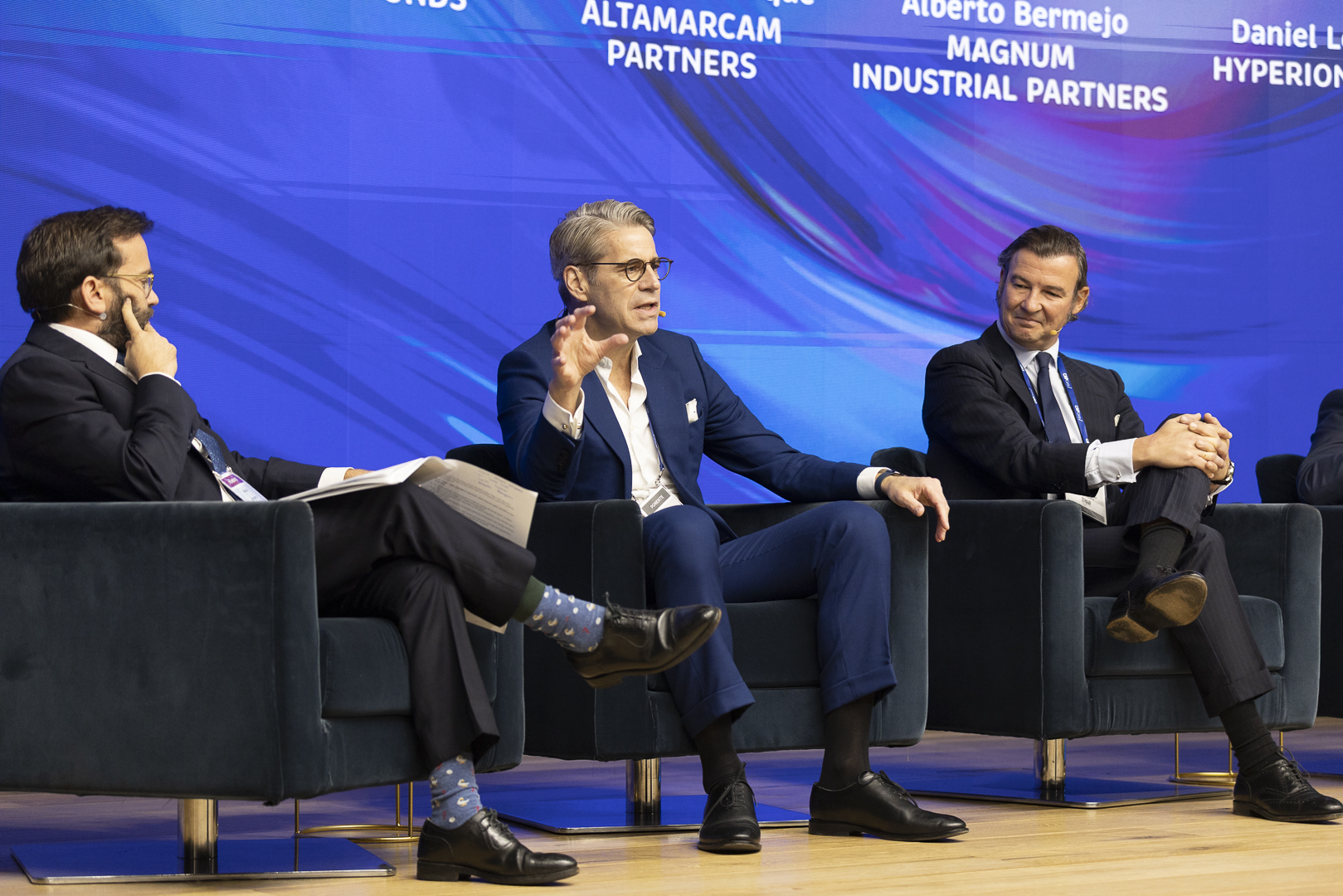
Organized by Capital & Corporate, the event brought together more than 400 professionals to discuss how the industry is navigating macroeconomic and geopolitical uncertainty.
Eric Halverson, Founding Partner of Qualitas Funds, spoke on the second day on the panel “The liquidity crunch: Is private equity entering a new era?”, alongside Miguel Echenique (AltamarCAM Partners), Alberto Bermejo (Magnum Capital Industrial Partners) and Daniel Lorrain (Hyperion Fund Partners), moderated by Pablo Méndez Reus (A&O Shearman). The discussion covered how the market will absorb the backlog of portfolio companies, the growing role of secondaries as a source of liquidity, the pressure LPs are putting on managers, and the impact of longer holding periods on future returns.
Returns and time horizon
Halverson started from one idea: private equity today has a returns problem. Before the 2008–2009 financial crisis, funds generated 300 to 400 basis points more than public markets. Since then, that spread has narrowed, in an asset class that requires investors to accept illiquidity and quarterly valuations that are sometimes debatable. “If I’m going to accept all the drawbacks inherent to private equity to get the same return as public markets, then we have a problem,” Halverson said.
Longer exits make the situation worse, and the reason is purely mathematical: selling a company after three years at twice the investment implies an IRR of about 26%; after four years, it drops to 19%, and after six, to 12%.
Why the lower-middle market
However, according to Halverson, the premium hasn’t disappeared, it has shifted: “In the European lower-middle market, the average net IRR still exceeds that of large funds by around 400 basis points.” To explain this, he drew on Qualitas Funds’ analysis of 25 years of data, 60,000 funds and 20,000 transactions. According to that study, just two factors explain more than half of the difference in returns between funds: multiple expansion and EBITDA growth.
On both counts, the lower-middle market has an edge. Funds in this segment have been buying at below 8x EBITDA for more than a decade, which makes multiple expansion statistically stronger. Smaller companies also grow faster: in deals under €50M, EBITDA grows by 100% on average, twice as much as in deals over €100M. “There are still opportunities to generate this return premium, especially in niches such as the European lower-middle market,” he concluded.
Selecting managers in a more demanding market
With LPs becoming more selective and fundraising cycles getting longer, Halverson also shared the keys Qualitas Funds applies when selecting managers, a task that, after more than a decade of experience, he admits is not easy. Only a third of top-quartile European funds remain in the top quartile in the next vintage, so relying solely on track record does not guarantee above-average returns.
That is why he focused on two factors that, according to Qualitas Funds’ analysis, best predict a fund’s success. The first is not increasing fund size too much, because the manager ends up competing in a part of the market that isn’t theirs, with more competition and higher prices. The second, and the one that surprised him most, is the management team’s own commitment: teams that invest less than 2% in their own fund achieve an average IRR of 10%, compared with 25% for those above that threshold, a gap much wider than he himself would have expected. “My advice to GPs is to invest more than 2% in their fund and, ideally, not to increase fund size,” he summed up.
New liquidity solutions
The discussion made it clear that secondaries are no longer a niche, but a structural part of the market. Along these lines, Qualitas Funds launched its first secondaries fund this year, of up to €100M, with access to non-intermediated opportunities thanks to its direct relationships with specialized managers.
The firm has also added NAV financing to its offering, a solution Halverson illustrated with a common case: a manager who, after five years pursuing a buy-and-build strategy, still has companies to acquire and only needs capital to complete it. NAV financing allows the manager to do so and sell in two or three years.
In a more demanding cycle, specialization, entry price discipline and the right selection of managers and segments will remain key to creating value.