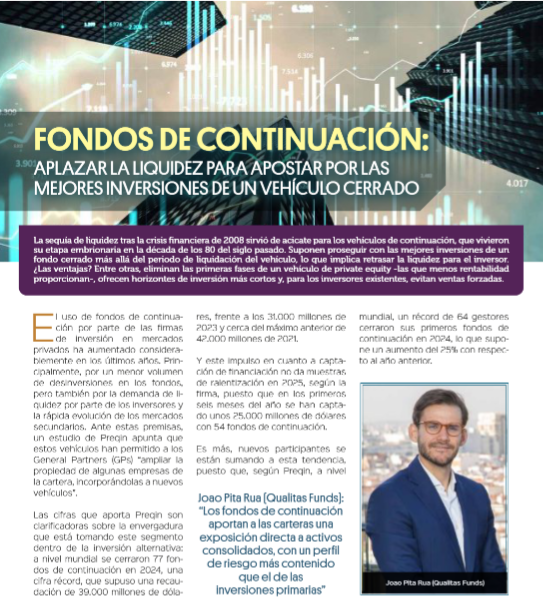
From the investor’s perspective, Qualitas Funds’ Investment Director emphasised that continuation funds “add direct exposure to seasoned assets to portfolios, with a more contained risk profile than primary investments”. These are generally companies with a proven track record and at advanced stages of value creation, which provides greater visibility into their future performance.
Another advantage highlighted by João is the shorter time horizon of this strategy. By focusing on assets in intermediate or late stages of development, continuation funds allow investors to “accelerate return generation and mitigate the J-curve effect, which is typical of traditional private equity funds”.
João also underscored the growing relevance of continuation funds, while acknowledging their inherent complexity, as a tool to diversify portfolios, balance the risk-return profile and optimise capital management in private markets. This reflects how these vehicles have evolved from being a one-off solution to becoming a structural element of the increasing dynamism of the secondary market.
Alongside João, various industry experts addressed the evolution and outlook of continuation funds in the Funds Society report. A joint effort to bring readers closer to the latest trends in these vehicles, whose high level of complexity means they are not always the most optimal solution. The key lies in aligning interests that are often difficult to reconcile, while at the same time addressing governance, valuation and execution challenges.