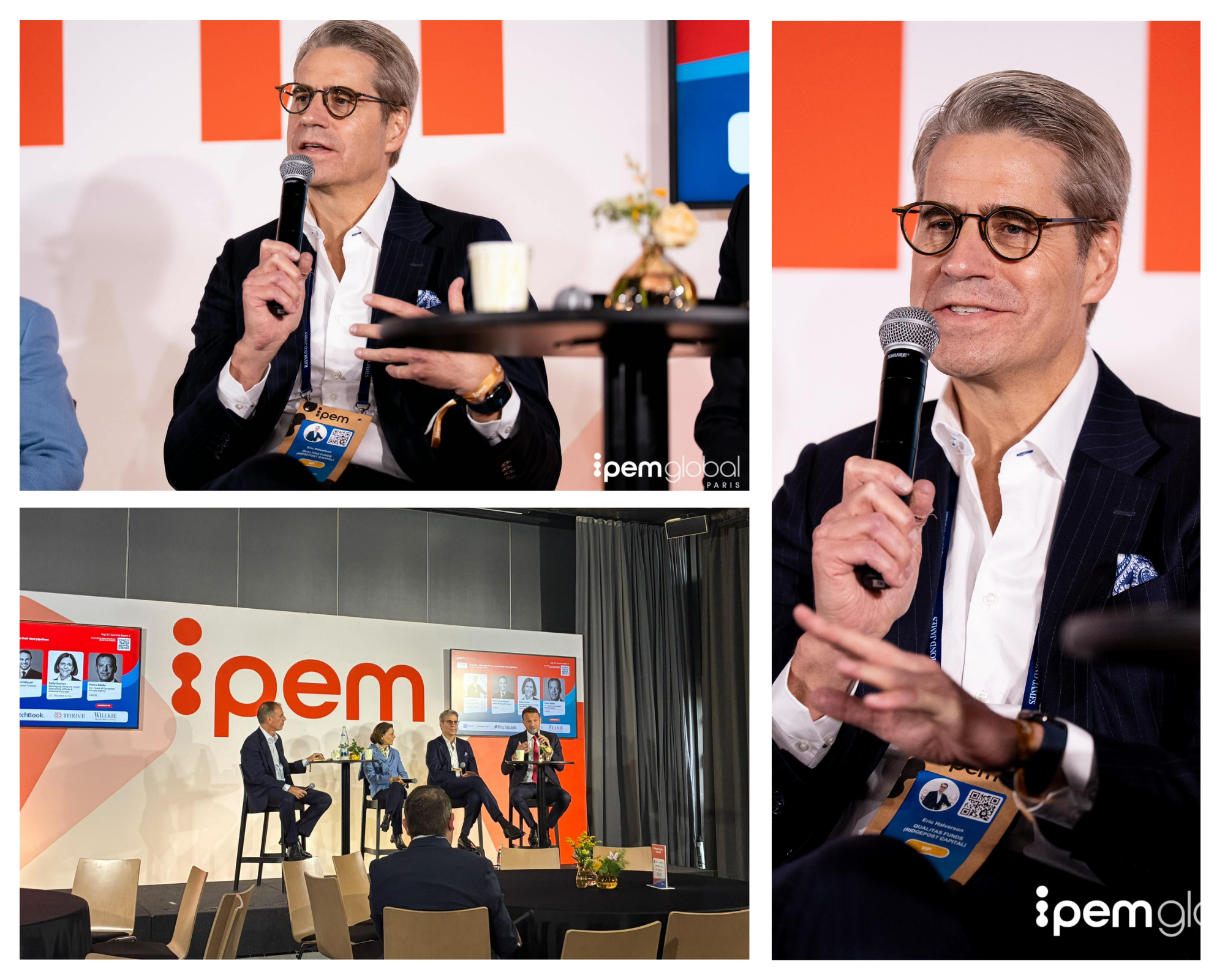
Against this backdrop, Eric Halverson, Founding Partner at Qualitas Funds, took part in the panel “Buyouts – What Top GPs See Inside Their Deal Pipelines”, which focused on the evolution of investment and exit opportunities, the changing dynamics of the buyout market and value creation through consolidation and buy-and-build strategies.
For Qualitas Funds, participating in IPEM Paris 2026 provided another opportunity to exchange views with international fund managers and investors and to explore in greater depth the trends shaping the future of private markets. Eric was joined on the panel by Emmanuel Miquel, Head of Buyout France & Managing Director at Ardian, and Sally Rocker, Managing Director, Chief Operating Officer & General Counsel at J.C. Flowers & Co. The discussion was moderated by Pietro Sibille, Co-Head of European Private Equity Coverage at Crédit Agricole CIB.
The discussion highlighted a more selective and demanding deal environment, driven less by debt availability or geopolitical volatility than by the challenge of bridging the valuation gap between buyers and sellers. Negotiation and transaction-closing processes are tending to take longer and require greater preparation, while execution has become even more critical in an environment marked by uncertainty and tighter financing conditions.
The panel also examined the evolution of valuations, fund DPI metrics and investment and exit pipelines. The recovery in exit activity and distributions remains one of the main areas of focus for managers and investors following several years of reduced liquidity. In this context, the market is closely watching the gradual convergence of buyer and seller expectations, as well as the different alternatives available to accelerate liquidity generation.
Value creation was another major theme of the discussion. In a market where multiple expansion and access to financing can no longer be taken for granted, the ability to generate genuine growth and operational improvements across portfolio companies is becoming increasingly important.
In this regard, consolidation and buy-and-build strategies continue to offer particularly compelling opportunities in fragmented markets. As Eric Halverson noted, “one of the main levers of value creation lies in building consolidation platforms capable of capturing economies of scale and accelerating growth through selective add-on acquisitions.” He added that “the greater fragmentation of certain sectors creates opportunities to pursue inorganic growth strategies that combine scale, operational improvement and specialization to build larger, more competitive companies.”
“Mastering the Course”: navigating a new cycle
Against this backdrop, the mid-market continues to offer an especially attractive opportunity set for specialist managers. This segment represents the majority of Europe’s corporate landscape, yet it continues to receive a relatively limited share of the capital allocated to private equity, creating inefficiencies and investment opportunities.
This reality reinforces one of the defining trends of the new private equity cycle: returns are becoming less dependent on multiple expansion or leverage and increasingly dependent on the ability to generate real growth. Investment discipline is therefore becoming even more important. Selecting resilient companies with robust business models and the capacity for sustainable growth, together with valuation discipline and a prudent capital structure, remains critical to navigating the different phases of the cycle. At Qualitas Funds, we see these principles as fundamental pillars of our investment strategy.
Artificial intelligence and technological transformation also featured prominently in the discussion. The debate is no longer limited to identifying companies directly exposed to AI, but increasingly extends to assessing how technology could transform entire sectors and business models, and which companies are best positioned to benefit from that change. One of the key factors will be the ability to translate technology into tangible improvements in revenue, costs and operational efficiency. “Mid-sized companies may have an advantage in this area thanks to their greater agility in transforming processes and implementing new solutions,” Eric added.
IPEM Paris 2026 therefore concluded another edition shaped by geopolitical change, technological disruption and evolving return expectations. This environment is prompting managers and investors to reassess their strategies, sharpen execution and reinforce discipline in decision-making.
In a more complex environment, the event’s own theme, “Mastering the Course”, neatly captures the challenge facing the industry. Navigating this new cycle requires conviction, discipline, specialization and execution capabilities, factors that will remain essential to identifying attractive opportunities and creating long-term value.