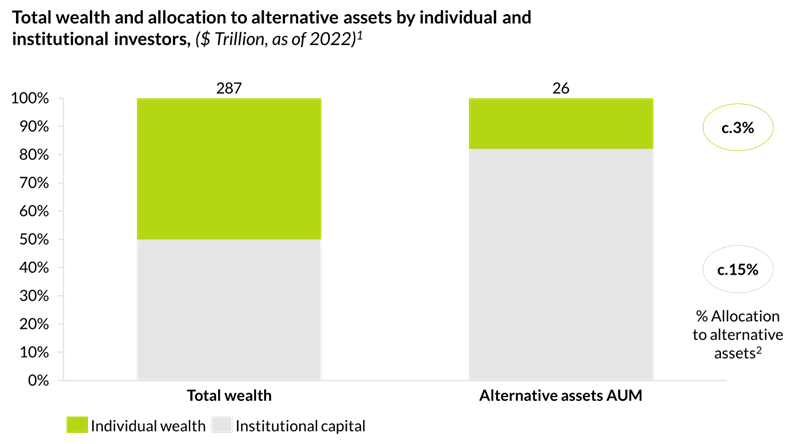
Individual investors concentrate close to half of the c.$287T of the wealth in the world1. However, they currently allocate less than 5% of their wealth to alternative assets, a significantly lower proportion than the allocation of institutional investors, which is close to 15%.
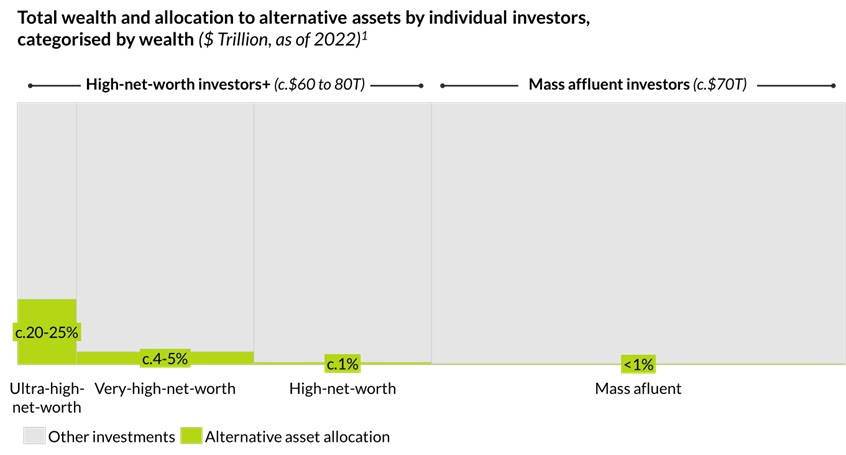
Notably, ultra-high-net-worth individuals with investable assets of more than $30MM allocate c.20-25% to alternative assets, and hence have higher allocations in comparison to institutional investors. However, both very-high-net-worth individuals (with investable assets between $5MM to $30MM) and high-net-worth individuals (with investable assets between $1MM to $5MM) allocate less than 5% of their wealth to alternative assets, bringing the total allocation to alternatives by high net worth individuals to c.5% on average. Additionally, the mass affluent population allocates less than 1% of their wealth to alternatives, further signalling the low allocation that individuals typically assign to alternative investments.
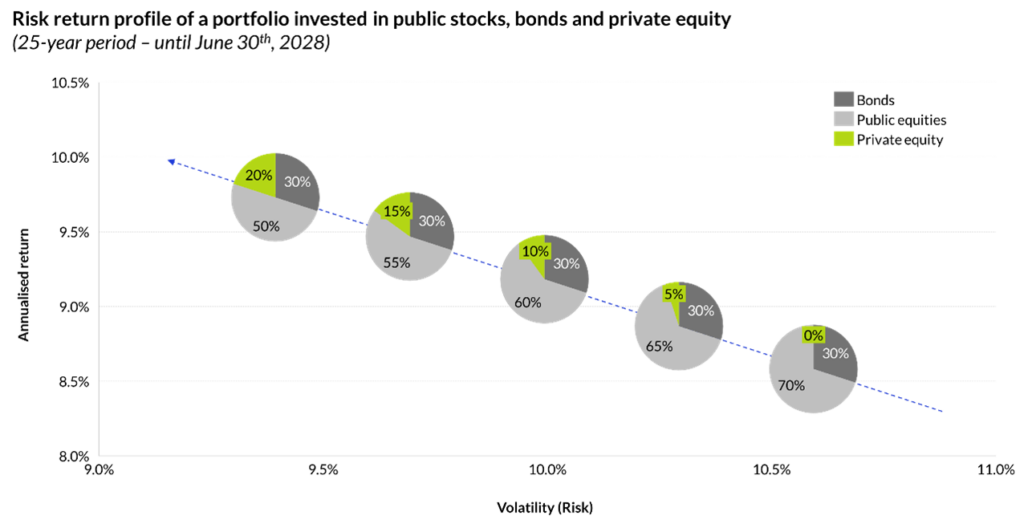
This lack of allocation to alternative investment happens despite the diversification benefits that are provided by introducing alternative assets into investment portfolios. A study carried out by Neuberger Berman proved that increasing private equity portfolio allocations from 0% up to 20%, systematically increased annualised returns and lowered the volatility of the portfolio, resulting in much more favourable risk-adjusted returns.
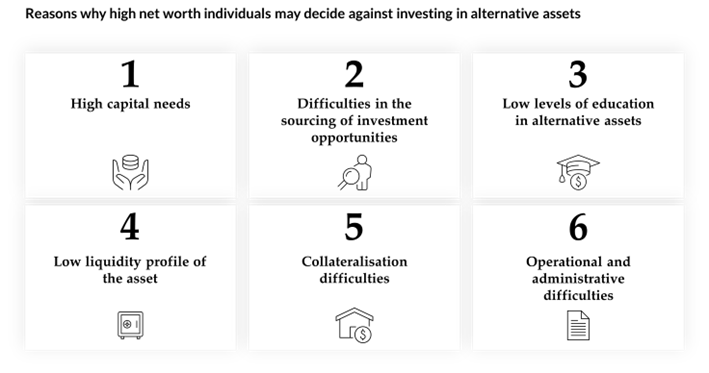
However, high-net-worth individuals are often under-allocated in alternative assets as a result of come inconveniences inherent in this type of investments. First, the absence of easily accessible marketplaces and sourcing channels may make it more difficult for individuals to explore and identify suitable and attractive alternatives’ investment opportunities. Additionally, the significant capital requirements necessary to achieve diversified exposure within the industry (with direct private equity funds often having minimum commitments of >€500k) prevent them from investing. Moreover, alternative assets can often be complex products, hence individual investors may not feel confident in investing in those assets. Furthermore, alternative investments often have lower liquidity levels than traditional assets, and most assets have difficulties in collateralisation, making it difficult for individual investors to leverage their investments. Lastly, the operational processes concerning alternative investments tend to be more cumbersome than those in traditional investments.
Qualitas Funds has created a product that mitigates the majority of these shortfalls of alternative investments. With a minimum investment ticket of just €100k, our investors get diversified access to a wide variety of opportunities in the European private equity lower mid-market, a space we believe has the best risk/return profile. Additionally, we have a strong investor relations focus to simplify the onboarding processes and lead in operational and reporting capabilities which effectively remove the burdens associated with investing in private equity.
As for the rest of the market, in the long term, tokenisation can further help mitigate other pain points that restrict individuals from investing in private equity. Tokenisation is a way of representing the property of an asset through a digital “token”. This is done through smart contracts. A smart contract is a programable piece of code which contains the records of ownership of an asset and rules for updating those records in the case a series of circumstances happen (e.g. the token is sold). In the case of private funds, the assets to be “tokenised” are LP fund interests.
Tokens act as an alternative recordkeeping system that could be used instead of traditional share registries and give access to the data to all relevant parties in the blockchain. Since all relevant parties have access to this data, a system can be created that automates tasks related to administration and operations, minimising costs and frictions associated with these activities.
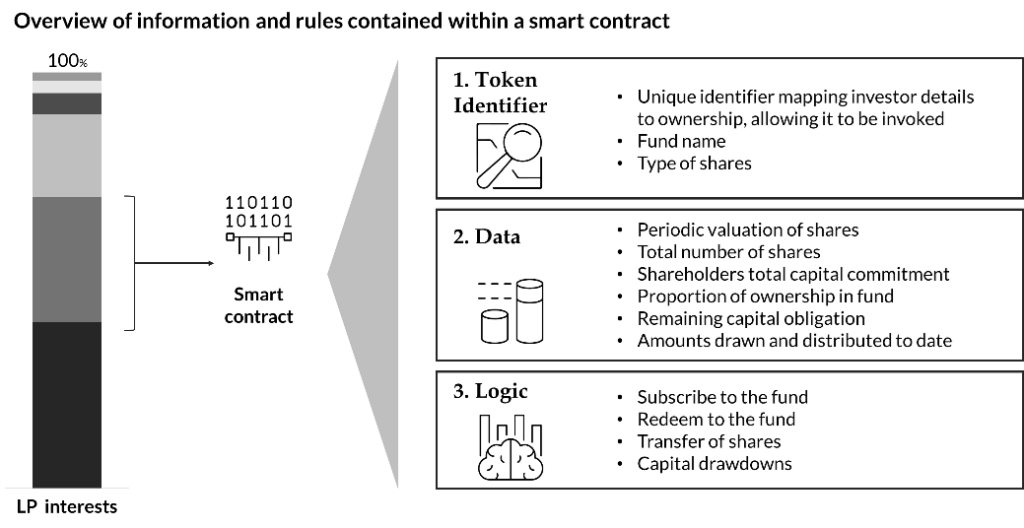
The automation facilitated by tokenization reduces operational burdens and costs, opening doors for fund managers to set smaller minimum ticket sizes for investors. This broader accessibility allows a larger proportion of individuals to tap into these investments. Furthermore, the streamlined order recordkeeping associated with tokens could enhance their cash convertibility for individuals, thereby improving liquidity for alternative assets, provided that relevant trade platforms emerge. The improved liquidity will make the assets more suitable for use as collateral, opening the possibility for investors to carry out leveraged investments in these kinds of assets. Hence, tokenisation has the potential to correct many of the issues that prevent individuals from investing in alternatives.
If realised to the full potential, tokenisation could also give rise to a wider range of possibilities for a fund of funds, including customisation3, in which individual investments are tokenised within the fund, allowing investors to adjust the weightings of the assets within their portfolio to their individual investment preference. Moreover, tokenization could automate capital calls for investors, streamlining processes and enhancing the efficiency of an otherwise tedious process.
In Qualitas Funds, we aspire to establish ourselves as the leading funds of funds covering the European lower mid-market. We strive to make technology one of our differentiators and have developed multiple in-house technology-led solutions to improve our day-to-day operational efficiency. Thus, we are following all the latest technological developments regarding tokenisation and aim to unlock these technologies in the middle to long term, so that individual investors can reap the full benefits from investing in our product.
Notes
Note 1: Source: Bain & Company report: “How tokenization can fuel a $400 Billion Opportunity in distributing alternative investments to individuals”. Approximations from figures 1 and 2 in the report.
Note 2: Indicative approximations of alternative assets allocation based on Bain & Company report.
Note 3: Sourced Onyx report: “The future of wealth management: Ultra efficient portfolios of traditional and alternative investments powered by tokenisation”.